Annual goals are the heart of an IEP. They describe what your child is working toward this year and give everyone a way to tell whether the plan is working. When a goal is vague, progress is hard to measure and easy to overlook.
You don't need a background in special education to review goals well. You need to ask a few consistent questions. This guide follows Part 4 of The Parent's IEP Meeting Preparation Workbook, Review the Current IEP.
Start With Present Levels
Every IEP must describe your child's present levels of academic achievement and functional performance, including how the disability affects their involvement and progress in the general education curriculum. Goals should grow directly out of this section. Before looking at the goals, ask:
- Does this describe my child as they are now, not two years ago?
- Are strengths identified, and are needs specific?
- Is current data included?
- Are the baselines clear enough to write measurable goals?
- Do present levels match the areas addressed by the goals and services?
If a need appears in present levels but has no goal or service, or a goal appears with no matching need, that is worth raising.
The Goal Quality Checklist
IDEA requires measurable annual goals, including academic and functional goals, designed to meet the needs that result from your child's disability. For each goal, check whether:
- The skill or behavior is clearly stated.
- The goal connects to an identified need in present levels.
- A baseline, your child's current performance, is known.
- The expected level of performance is clear.
- The goal can be measured consistently.
- The method for measuring progress is clear.
- The goal is meaningful for your child's participation and progress at school.
- You understand what success will look like.
Vague vs. Measurable: An Example
Vague: "Sam will improve his reading skills."
Improve from what, to what, measured how? Anyone could call almost any result "improvement."
Measurable: "Given a grade-level passage, Sam will read aloud at 90 words correct per minute with 95% accuracy, measured by biweekly fluency probes, by the annual review. (Baseline: 62 words correct per minute.)"
Now everyone knows the starting point, the target, how it will be checked and when. These numbers are only an illustration. The right target for your child depends on their own data.
Compare Each Goal With the Data
For every goal, line up four things: the baseline, your child's current performance, the expected target and whether they are making progress. The IEP must explain how progress will be measured and when you will receive periodic progress reports, so compare what the plan promised with what you have actually received.
If a progress report says "progressing" with no numbers, ask for the data behind it. If progress is limited, ask: "What will we do differently if the data show this approach is not working?"
Don't Confuse Accommodations and Modifications
While you review goals, look closely at any modifications. An accommodation changes how your child learns or shows what they know, such as extended time or text-to-speech. A modification changes what your child is expected to learn or demonstrate. Modifications can affect whether a student earns a standard diploma, so ask the team to explain the implications under your state and district requirements.
Questions to Bring to the Meeting
- Why are these goals being recommended?
- What is the baseline for each goal, and where did it come from?
- How and how often will each goal be measured?
- What will I receive to monitor progress, and when?
- Which goals do you recommend keeping, revising or adding, and why?
Review Goals With the Workbook
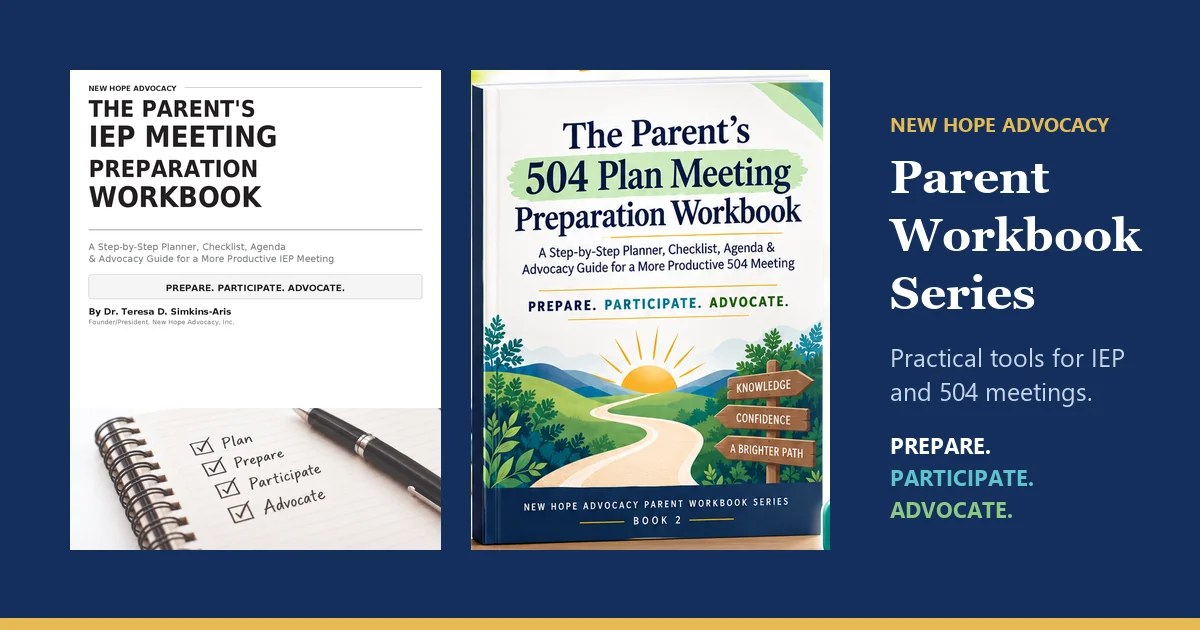
The IEP workbook gives you a Present Levels Review, goal review tables for each goal, the full Goal Quality Checklist, a Progress Monitoring Review, accommodation and modification reviews and a Goal Decision Log to capture what the team decides in the meeting.
See The Parent's IEP Meeting Preparation Workbook →
Keep every IEP and progress report in your Member Vault, and you can compare goals and data year over year in minutes.
This article is general educational information, not legal advice. Federal law sets a baseline; your state and district may add requirements or timelines. Use the most current procedural safeguards notice from your school district or state.
Prepare. Participate. Advocate.
Have questions or need support?
Our team is here to help. Reach out and we'll get back to you.
Connect With UsNew Hope Advocacy
Author